Click an event title below to purchase tickets
Details
Click here to download a PDF of this information.
Innovate & Discover: Engineering Solutions in Central Texas
Welcome, young scientists and engineers! Are you ready to use your super STEM skills to solve real problems right here in Central Texas? This year, we want you to think about how science, technology, engineering, or math (STEM) can help design a solution or create something new that makes a difference in our community. Get ready to innovate and discover!
General Information
Eligibility
Any student between the ages of 8 and 18 can participate! Whether you're a lone scientist or working with a team, we want to see your amazing ideas.
Entry Fee
A non-refundable entry fee will be required in order to participate.
- $25 for individual entry
- $40 for team entry
- First 7 entries will receive a free trifold board
- Deadline for entry form and payment is January 30, 2026
Originality & Adherence to Theme
The student or team project should be your own idea! We’re looking for fresh, creative ways to solve problems. All projects must represent the original work of the participant(s). While it is okay to get help or advice from parents or mentors, the main idea, experiments, data, and results must come from the student or team. Plagiarizing someone else’s work is not allowed in any form and will result in disqualification. Make sure your project fits the theme, “Innovate & Discover: Engineering Solutions in Central Texas,” and demonstrates a STEM-based solution or discovery that addresses a real-world problem in the region.
Scientific Method
If you're doing a science experiment, remember to follow the scientific method! That means:
- Asking a question
- Doing research
- Making a hypothesis (an educated guess)
- Testing your hypothesis with an experiment
- Analyzing your results
- Drawing a conclusion
Engineering Design Practice
If you're building or designing something, you'll use the engineering design process:
- Asking: What's the problem?
- Imagining: What are some possible solutions?
- Planning: How will you build it?
- Creating: Build your solution!
- Improving: How can you make it better?
Safety & Ethical Considerations
Your safety is super important! Please read these rules carefully.
Adult Supervision
An adult must help and supervise you for all experiments and building, especially when using tools or working with electricity.
Prohibited Materials
To keep everyone safe, please do not use:
- Live vertebrate animals (mammals, birds, reptiles, amphibians, fish)
- Dangerous chemicals
- Harmful bacteria, fungi or molds
- Human or animal body fluids (e.g., blood, urine, tissue)
- Open flames or highly flammable materials
- Weapons or sharp objects
- Illegal substances
Human Participants
If your project involves people (like asking them questions in a survey), you need to get written permission from them and their parents (if they are under 18) first. Their participation must be voluntary. A consent form will be provided to all students upon request.
Animal Use (Invertebrates Only)
You can only use invertebrates (animals without backbones, like insects or worms) in your projects. Please treat all animals kindly and make sure they are safe and comfortable. Live animals will not be allowed to be displayed at the showcase; photos or videos are allowed.
Environmental Responsibility
Think about how your project affects the environment. Try to use recycled materials and be mindful of waste.
Electricity/Power
No open flames are allowed. If your project uses electricity, ensure all wiring is safe and properly insulated. An adult must check your electrical setup before use.
Display & Presentation
Your display is how you show off your amazing work!
Display Board
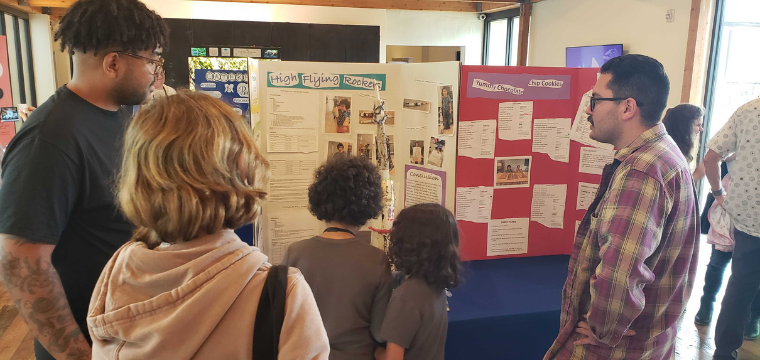
Use a sturdy tri-fold display board (typically 36" tall x 48" wide when open) to present your project. Make it colorful, easy to read, and visually appealing. Use clear headings, simple language, and engaging pictures.
Project Documentation Summary
Your project summary should be a short, clear explanation of your project. A printed copy of your final summary must be taped to the back of your display board.
Your project summary must include:
- Title
- Introduction: What problem you're trying to solve
- Materials and Steps (detailed steps to replicate): What did you do? How did you design a solution?
- Results: What you found out or created
- Discussion and Analysis: What it means for Central Texas
- Conclusion
- Bibliography/References (citing all sources, including websites, books, and expert advice. Any standard citation style is acceptable, as long as it's consistent and clear.)
No Loose Materials or Valuables
All parts of your display should be securely attached. No loose papers or objects, please! Do not bring expensive or irreplaceable items to the fair. We can't guarantee their safety.
Size Limitations
Your display board should be no larger than 36 inches wide by 36 inches deep, and no taller than 30 inches. Any models, prototypes, or equipment you bring must fit on a table space.
Branding
Avoid the use of real brand names or logos on your display, especially if you’re comparing products. You can simply use labels like “Brand A” and “Brand B” instead.
Photos
Use photos to show different parts of your project! If you include pictures of people, sure you have a signed photo release from them. A photo release form will be provided upon request.
No Live Specimens
Please do not bring any live animals (even invertebrates) or plants to the fair for display. Photos are acceptable.
Judging
Judging Criteria
Judges will be looking for:
- Scientific Thought/Engineering Goals: How well did you think through your project? How clearly did you explain your problem, hypothesis, methods, and conclusion?
- Creativity & Originality: Is your idea new and exciting?
- Thoroughness & Skill: How well did you carry out your project?
- Clarity & Presentation: Is your project easy to understand and well-presented?
- Relevance to Central Texas: How does your project help our community?
Awards
Awesome projects will receive awards! There will be medals and prizes for different age groups and categories. Good luck!
Categories
Individuals |
Teams |
|---|---|
|
Students working on their own projects. |
Max of three students working together on a single project. Participants must be within the same age category. |
|
Each individual project will be judged independently. |
Team projects will be judged on the combined effort and collaboration. |
|
There will be 3 categories:
|
There will be 3 categories:
|
Registration & Important Dates
Ready to join the fun? Here's what you need to know:
Registration Deadline
Make sure to register your project and pay the entry fee by January 30, 2026! Late entries will not be accepted.
Google Classroom and Informational Meeting
Your project will be reviewed and approved by Science Mill staff before you begin. We’ll use Google Classroom throughout the project, and you’ll receive an invitation to join once all registration information has been submitted and approved. We will have a virtual meeting on February 3, 2026 at 5:00pm that is required for all participants. A meeting link will be sent once entry is received.
Project Support
Need help with your project? We’re here for you! Science Mill Educators and Mentors are available for help through our private Google Classroom. You will be able to send a message or you can request a virtual meeting if you want to meet face-to-face for help. Instructions on how to access and use Google Classroom will be sent after registration closes.